• As Life Would Have It

Jean's Blog of Life, Farms and Everything

~ Welcome to life on our mini-farm in the AriDzona desert!

Jean's Blog of Life, Farms and Everything

Monthly Archives: July 2013

Daffies

28 Sunday Jul 2013

Posted by William in General Farm Stuff

≈ Leave a comment

We used to watch the science fiction TV show Babylon 5, especially the third year before it got preachy and anti-climactic.  One of the fairly main characters vanished for a half-dozen episodes, missed and presumed dead, so some of his friends gathered in his old quarters to have a kind of memorial for him.

G’Kar, an alien character, noticed a big poster of Daffy Duck in mid-rant on the wall.  “What does this mean?” he asked.

“Oh, that’s Daffy Duck,” one of the humans said.  “Sort of the patron saint of frustration.”

Because of that, I like to measure the frustration potential of things around the farm in Daffies.  “Oh, that looks like a three-Daffy task” or “Ugh, fixing that is going to involve potentially HUNDREDS of Daffies.”

DSC00219

The Big Tractor:  0 Daffies

This is our big tractor, a 1956 Ford 850.  This tractor has been basically bulletproof and has given us almost no difficulty at all.  I had to replace the battery once, I had to replace a spark plug wire that I snagged on a tree branch, and I’ve had to fix one flat front tire and replace the right rear tire entirely when it finally went flat and couldn’t be repaired (the rim had rusted so badly the tire shop couldn’t even dismount the tire without tearing the rim up).  It pulls hard, it doesn’t leak, and it doesn’t overheat, and it starts every time unless you make the mistake of choking it and getting it all loaded up (even then, it’ll eventually start, but it sputters for a while and pukes out thick clouds of black gasoline smoke till it clears itself out).
Bolens_rear

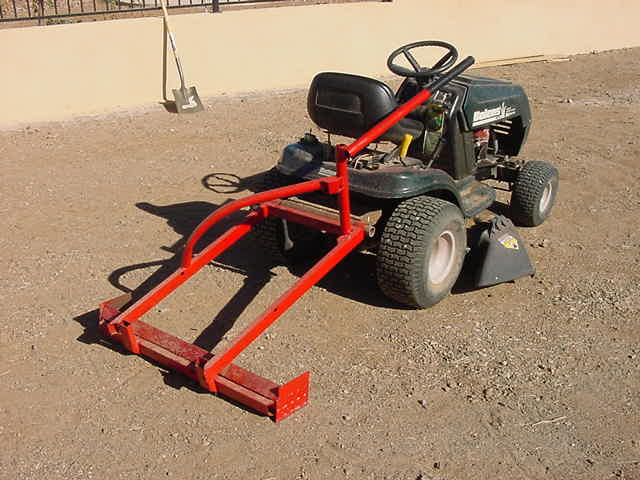
The Little Tractor:  74 Daffies

This is a plain old belt-drive 21.5 horsepower lawn tractor that I bought at Lowes for about $800 one year.  It has actually given pretty good service over the years, but I think we just use it harder than it likes.  It’s designed to mow lawns, and as you can see, we use it for earthmoving, grading, and manure handling – not tasks that it was ever designed to handle.

It eats up batteries at a furious clip, and almost always has to be jump-started.  I had to replace the carburetor once because the float needle seat wore out and the needle valve wouldn’t seal, so about a gallon of gasoline slowly made its way through the carburetor, into the cylinder and crankcase.  This hydraulicked the engine so hard it wouldn’t turn over at all, and when I pulled out the spark plug, it gushed gasoline out the spark plug hole like one of Rockefeller’s favorite oil wells.  I put a fuel shut-off valve in the fuel line to stop that from happening again, but now the bushing that the throttle butterfly shaft goes through has a big crack in it, so it runs terribly lean and the engine speed wanders wildly.  I’ve got the crack packed with gasoline-proof gasket compound and so far it’s holding, but eventually it’s going to need ANOTHER new carburetor.  Oh, and the entire gas tank imploded once (though I managed to find a replacement on Amazon.com, of all places).

I had to replace all four tires.  After a couple of years, they all developed literally hundreds of tiny pinhole leaks all across the tread surface, and there was just no fixing that.  I managed to get the front tire beads set myself, but I never could get the rear beads to set (the new tires were pretty stiff).  Jean had to take them to Discount Tire in town so they could set the beads.  The good news is that the new tires have been pretty tough – occasionally we’ll get a mesquite thorn in one, but that’s relatively easy to fix with a tubeless plug kit.

I made the scraper attachment myself by cutting and welding a bunch of metal scrap.  It works pretty well.  It won’t dig, really, but it does a good job of dragging manure around and working it into the soil (we have four turnouts.  I can get the big tractor into three of them, but the fourth has a narrow gate and only the small tractor fits through it).  It’ll also knock down dry weeds, spread gravel and so forth.

It’s hard to start, and depending on how well the crack in the bushing is sealed, it may or may not run well once it gets started.  But I’ve used it and a little dump trailer to move mountains of dirt, rock, and gravel.  I’ve laid a bunch of walkways by hand, and I drop the mower deck and use it to do the final finish grading on the walkways before I start laying pavestones.  In short, this little tractor has put in a lot of hard service it was never intended to do, and though its incessant battery and carburetor problems frustrate me intensely, I can’t really blame it.  It thought it was going to go off and mow a lawn once a week, not drag manure around or haul 20 tons of gravel or drag big mesquite limbs out of the so-called “tree turnout”.

Oh, and some kind of leafcutter wasp tried making a nest in the ignition switch slot.  I’ve picked at it with a dental probe for some time, but the ignition switch is still full of organic crud and it takes some effort to push the key in far enough to unlock the ignition switch.
Share this:

  • Share on X (Opens in new window) X
  • Share on Facebook (Opens in new window) Facebook
Like Loading...

Fauna

28 Sunday Jul 2013

Posted by William in Rural life

≈ Leave a comment

MVC-008S

Go away!  I’m not dead, I just sort of look like it!

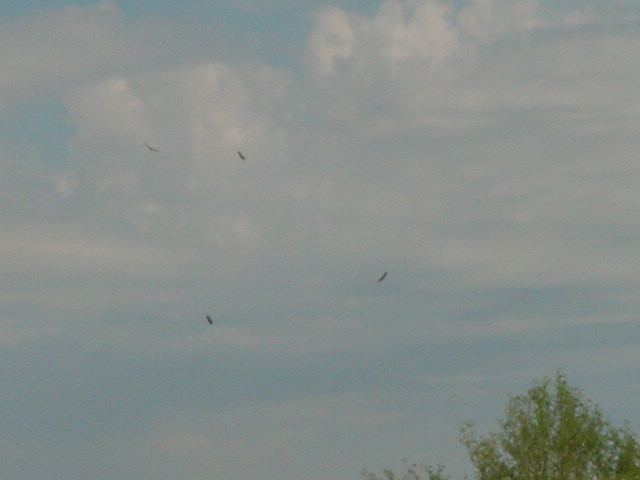
It may be hard to make out what this is a photograph of, but it’s vultures.  Buzzards.  Whatever you want to call them.  They spotted me working outside and you can tell they’re thinking “Oh, hot dog!  If the big guy keels over, we’ll eat like kings!”

MVC-007S

Cute.  At first.

I’m an Arizona native, and I’ve lived much of my life in Phoenix.  And never in Phoenix did I ever see these extremely common sorts of wildlife.  But out here, in the relatively unspoiled expanses of the Sonora Desert, they’re about as common as dirt.

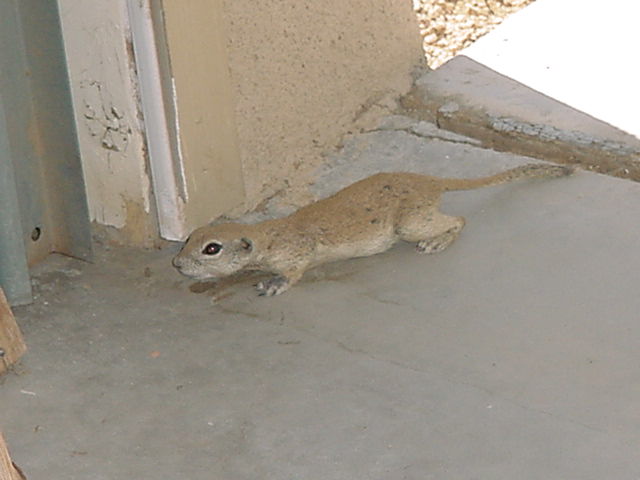
And they’re oddly linked.  The little squirrels (Xerospermophilus tereticaudus, if you’re interested)  hold frequent club initiation rituals on the roads around here, where they make the new guys run pell-mell out in front of cars before they’re allowed to join the squirrel club.  Sometimes they don’t make it, and that’s where the vultures come in.  Some mornings, going to work, I’ve had to slow down and toot my car horn because of the big packs of big, ugly, bad-tempered birds hunkered down in the middle of the road around a former squirrel.

Moving from the city to the country presents one with a great many shocks.  The sheer openness of the landscape, and the relative lack of fences, can induce a sort of agoraphobia till you get used to the fact that you don’t have to hunker down in a block-walled back yard like some kind of political prisoner.  The ability to see the horizon can be kind of shocking at first, especially when you’re used to not seeing anything but the side of the neighbor’s house.

But the sheer quantity and diversity of wildlife is amazing.  We’re used to thinking of deserts as lifeless wastelands.  There are such lifeless wastelands; parts of the Atacama Desert are so dry there aren’t even any bacteria.  But the Sonora Desert fairly teems with creatures, at least by desert standards, and usually in forms that you simply never see in Phoenix.

When’s the last time a Phoenician saw, say, a tarantula in the wild, or vultures circling overhead, or those dratted little squirrels, or pack rats, or lizards in such amazing diversity we can’t even keep them straight?  (“Did you see that big lizard?”  “Was it one of those fat ones, or the stripey ones, or the yellowish ones with the curled tails, or…”  “Well, it was kinda fat, and kinda stripey…”)

And the bugs!  There are more weird bugs than Carter has pills!  Tarantulas, solpugids, blister beetles, big placid black ants, small and vicious red ants, hoverflies, dragonflies, tarantula wasps, centipedes, Palo Verde borers, carpenter bees…

This all sounds pretty hairy, I’m sure, all this talk of wasps of giant spiders and other stinging, biting, malevolent insectoid hostility that stalks the bushes (the sting of the tarantula wasp is said to be one of the most painful stings in the world, able to drop a man in his tracks and make him scream out confessions to crimes not yet committed).

But in Phoenix, as a city dweller, one lives in opposition to life.  The default reaction to any kind of bug is to kill it, as quickly as possible.  And sometimes, out here in the country, it is necessary to do the same, simply as a safety measure.  You can’t have wasps build nests under the eaves of the house, or let rattlesnakes have free reign over the farm, or suffer swarms of possibly Africanized bees to build hives next to the garage door.  And sometimes the sheer destructiveness of the squirrels can drive one to red fury, like when they gnaw a cactus off at ground level and leave the top part to die, or when the pack rats gnaw through $800 worth of vacuum tubing in one’s pickup truck.

But out here, in the country, I find it pleasing and calming to live with the wildlife, rather than against it.  I don’t like tarantulas and big hairy scorpions, but as long as they respect my right to go out in the garage barefoot, I respect their right to scuttle and tunnel and scheme out in the dry wash.

This was supposed to be an introduction, but I got carried away.  This is a lifelong flaw in my character.  I don’t always have much to say in person, but put me at the helm of a computer and I just won’t shut up.


Share this:

  • Share on X (Opens in new window) X
  • Share on Facebook (Opens in new window) Facebook
Like Loading...

Gate Safety Lesson: provided by “Weena da Queena”

28 Sunday Jul 2013

Posted by Jean in Wee Horses

≈ Leave a comment

Weena da Queena, equine product safety engineer

Weena da Queena, equine product safety engineer

This will be one of many posts regarding safety around the barnyard. More will be added as the horses figure out other ways to get themselves into trouble and as I remember past times they’ve gotten themselves into trouble. I’ll generally need to post these in the daylight hours as too close to bedtime and I’m liable to have nightmares or lay awake wondering “What was that noise?! What did they do now???”

We started with one barn, added a second barn about 20 or so feet from the first, and have now enclosed that space between them and added two covered stalls and a covered hay area. As the space between the two barns did not accommodate our 12 foot gate panels, we improvised with chain link gates. This worked very nicely until we put a horse in them. I led little Rowena into one, closed her gate, put a horse in the new stall next to her and before I got that gate closed the sounds of panic came from Rowena’s stall. I looked, my heart stopped, my stomach lurched and my body levitated the 20 feet necessary to rescue Rowena who had managed to trap the back of her neck between the gate and the post.

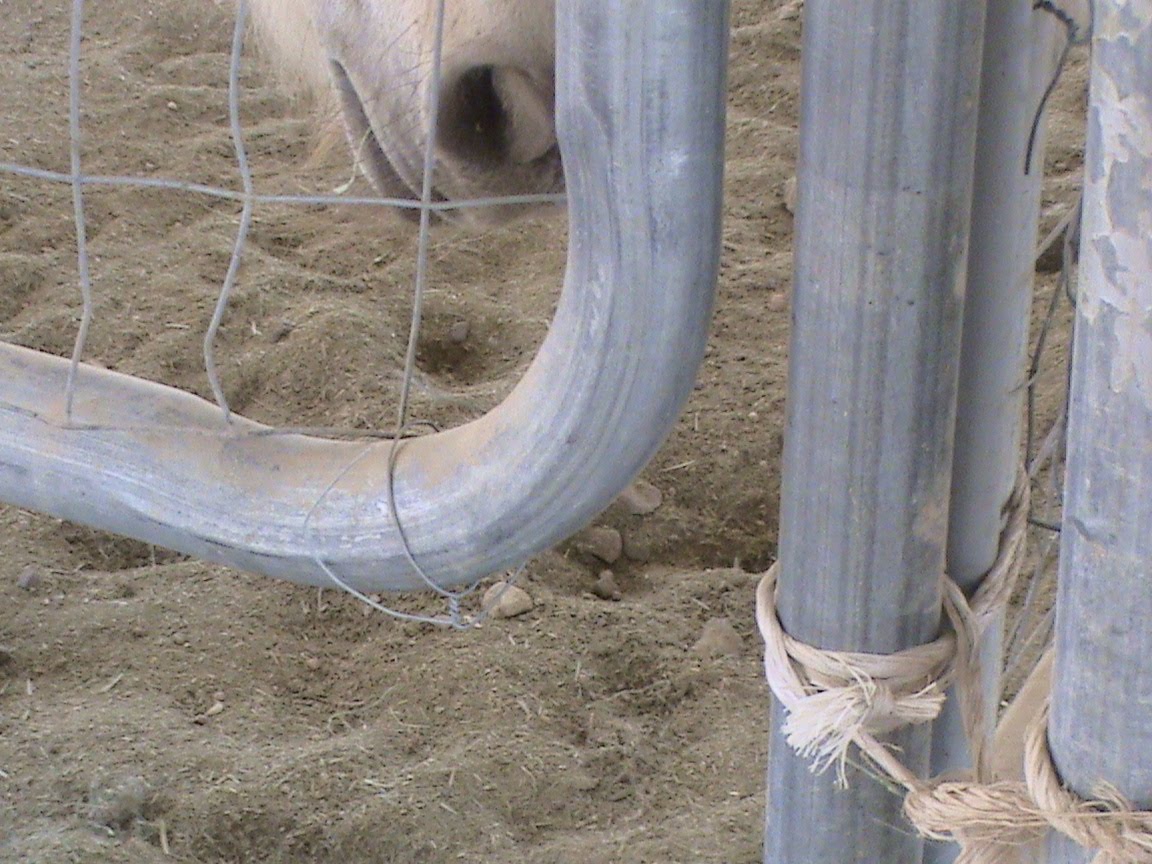
The bottom of the chain link gate is curved. We’d hung it about 10 inches above the ground so it swings easily. Little Weena, in her never ending search for stray bits of hay had stuck her head out the bottom of the gate to try and reach some edible tidbit or other and when she pulled her head back, the slim part of her neck, right where it joins her head, went up into the slot created by the curved bottom of the gate. She was so panic stricken that it’s a major miracle she didn’t separate her head from her body or snap her neck.

After that incident, we kept larger horses in that stall, but they too have slender necks that could fit into that slot. We ended up replacing that set up with two regular gate panels that overlap in the middle. We’d also never noticed that several of our regular gate panels have that curved bottom. We’ve tied rope, chain, no-climb, hardware cloth,  and bungee barriers across the curved neck catching gates, but every day I go out there I’m scared I’m going to find a horse that has managed to get past our flimsy precautions and killed itself. We’re going to have to weld a bar or bolt a board from the bottom of those gates and across the open space the curves create in order to truly fix the problem.

Below are photos of the safe straight gates and the unsafe curved gates.

Unsafe gate: notice the Weena snoot hovering near the place she can get in the most trouble.

Unsafe gate: notice the Weena snoot hovering near the place she can get in the most trouble.

Safe gate: notice the lack of a Weena snoot. If they can't get into trouble with it, it is uninteresting.

Safe gate: notice the lack of a Weena snoot. If they can’t get into trouble with it, it is uninteresting.

Share this:

  • Share on X (Opens in new window) X
  • Share on Facebook (Opens in new window) Facebook
Like Loading...

It’s a Dry Heat

27 Saturday Jul 2013

Posted by Jean in General Farm Stuff

≈ Leave a comment

Not during monsoon season dearies. It’s a wet heat and those of you who tell me wet heat is worse than dry heat need to come visit for 3 months out of the year. You’ll get a taste of both dry and wet heat.

During the summer monsoon it is common to have a 70% humidity along with 100-108 degree temperatures. Prior to monsoon season, it is common to have 110-120 degree temperatures. The difference is a comparison between sitting in a sauna or sitting in a kiln. HINT: People often pay to sit in saunas. After a week of 10% humidity and 112-120 degrees frying eggs on the pavement, baking cookies on your dashboard and risking heat stroke while walking to your mailbox, you’ll be excited for the cooler 105 with 70% humidity.  Ask the lizard my husband witnessed doing a 50 yard dash from the dry wash to the garage where it came to a stop next to his foot. The poor critter was so hot he didn’t care about that size 14 shoe that could have turned him into reptile mash.

As someone who spent most of her life in Louisiana, unless you are from Louisiana, you don’t know humidity. 95 degrees and so much humidity you can soap up and rinse off in the sun on your way to your car in the morning still feels cooler than 118 degrees. Sure you sweat more, but you’re still not as hot as you are when it’s 118.

Speaking of sweat, I realize this is supposed to be the body’s cooling system, but has anyone ever, anywhere, felt cooler when the body is producing more precipitation in an hour than the desert gets in a year? As far as I’m concerned, sweat as a body’s natural air conditioner is a massive fail. We should have kept our tails and evolved solar powered fans at the ends of them.

Share this:

  • Share on X (Opens in new window) X
  • Share on Facebook (Opens in new window) Facebook
Like Loading...

A Day in the Life

26 Friday Jul 2013

Posted by Jean in General Farm Stuff

≈ Leave a comment

Tags

farm, horse, miniature horse

This is actually from an old blog from several years ago.  My father was in poor health and mentioned he wished he could have seen our little horses. We spent a day working to put a picture in stories together for him. He passed away just a couple of weeks later so I’m sure glad we got the idea to do this for him. A year later we lost my beloved “Honey”, the buckskin mare in the good grooming picture, and just this year our much loved Anniedawg passed away on Easter Sunday. My big brother lost his war with cancer, but my wonderful husband emerged victorious over Hodgkin’s Lymphoma. Things got tough and scary in the years since I wrote this blog post, but the little farm goes on with fresh hope, new furry faces and cherished memories.

Here at the miniature horse farm we rise at around 5:30-6:00 each morning, creak our way slowly out of bed and stumble toward the coffee maker. We wake up via caffeine I.V. while checking email and reading news on line, then we head for the medicine cabinet and hit the dated, categorized, carefully compartmentalized pill boxes that we’re told keep us living. Then we dress and sit dumbly on the edge of the bed, as if our boats fetched up in mud, while our engines try, re-try and try again to turn over. Mostly what we get is that “tick, tick, tick” sound of a bad battery. Eventually, however, we sputter to a start and mosey out to the barn to feed the horses around 7-ish.

goodtobeshortblog

Being short has it’s priveleges.

Then we feed horses. Horses who today are standing out there, tapping their toes, and not at all happy that breakfast is late. Rowena is determined to chase William down for her bowl because as you can see the poor baby is emaciated.

gimmemyfood2

Handsome is turning himself into a giraffe trying to inhale his feed straight out of the scoop before I can dump it in his feeder.

feedinghandsomehossblog

William and John handle the heavy chores around here, lifting those bales, toting that poop and such. (Imagine Green Acres theme playing in the background)

merikangothicblog

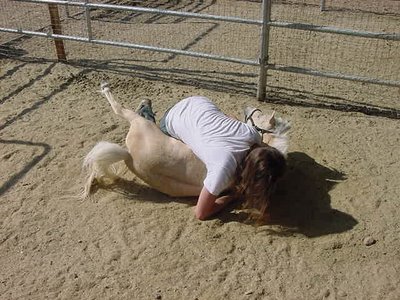
John also handles the WHW (Wittmann Horse Wrestling) duties whenever anyone gets out of line.

desiwrestlingblog

desigoesdownblog

While the horses eat we check the garden for ripe veggies so the rabbits and squirrels don’t make off with them first. The rabbits have finally gotten desperate enough to eat zucchini. Looks like we’ve been raided overnight AGAIN.

rabbitetzucchiniblog

Gol-durn rabbits! We’ll show ’em!

durnrabbitsblog

Then, it’s time to ride out and check the fence lines.

rideemoutblog

Good grooming practices are part of the daily routine, at least for the 4- legged residents. Folks wouldn’t recognize me without hay in my hair.

propergroomingblog

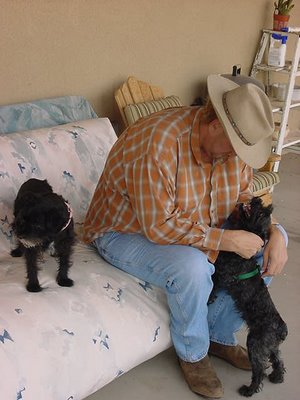
William tries to explain the concept of rabbit hunting to Elmo and Anniedawg. They just want their biscuits and bacon thanks.

baconhuntersblog

On weekends we love to watch the televised PBR events after the evening chores.

watchinpbrblog

watchinpbrtooblog

And that’s pretty much our day, minus the tractor work, house work, nap and writing!

DISCLAIMER: No herbivores were harmed during the making of this blog post.

Share this:

  • Share on X (Opens in new window) X
  • Share on Facebook (Opens in new window) Facebook
Like Loading...

Posts, stories, woes, vittles, photo and video evidence

Categories

Enter your email address to follow this blog and receive notifications of new posts by email.

Join 45 other subscribers

Current woes, tall tales, and lessons learned

  • Here are the mutts.
  • January Cure 2018- Flowers and Floors and Stuff
  • January Cure 2018 Day 2- Make a list
  • January Cure 2018- Day 1- Clear and Organize a Drawer
  • January Cure 2018: But first a word from our sponsor
  • January Cure Weekend 1- Flowers and Floor
  • Day 3 January Cure 2017- Purge the Pantry vs Cabinet Cleanout
  • Day 2 January Cure 2017- Making a List (humming- checking it twice)
  • January Cure 2017 Day 1
  • Billiam’s List Bedroom Tile: Pat us on the head!

Tags

cabinet cabinet doors chickens cleaning cleaning house cleaning stainless death of spouse desert gardening DIY diy chair do it yourself dreams of dead spouse easy bedspread easy cotton bedspread egg bound farm floors garden garden bed gardening grief hanging bed heirloom squash hens home cleaning home decor home furniture home improvement homemade furniture home organization horse house cleaning how to handle grief how to hide cord clutter how to make serving trays January Cure January Cure 2016 January Cure 2017 January Cure 2018 landscaping mayo arrote miniature horse no sew bedspread off road wheelchair organic gardening organizing ottoman outdoor furniture outoor furniture pallet patio patio chair patio furniture pumpkin serving trays squmpkin storage bench swinging bed TankChair tank chair tech storage tie-dye tie-dye bedspread to-do lists tools tracked wheelchair tree trimming upcyle cabinet door upholstery wood chair wood craft wood crafts wooden chair wood furniture yard

Blog at WordPress.com.

  • Subscribe Subscribed
    • Jean's Blog of Life, Farms and Everything
    • Join 45 other subscribers
    • Already have a WordPress.com account? Log in now.
    • Jean's Blog of Life, Farms and Everything
    • Subscribe Subscribed
    • Sign up
    • Log in
    • Report this content
    • View site in Reader
    • Manage subscriptions
    • Collapse this bar
 

Loading Comments...
 

    %d